What Order Should I Plan for Retirement in Australia?
Published 22 October 2026 · 10 min read
Retirement planning can feel complicated for a fairly simple reason.
There are a lot of things to think about.
Your super. Your budget. The Age Pension. Your home. Travel. Healthcare. Estate planning. When you want to retire. And, of course, whether the money you have will actually support the retirement you want.
The problem is that trying to tackle all of those things at once can make retirement planning feel harder than it needs to be.
A better approach is to put the jobs into a practical order.
There is no single government-prescribed sequence that everyone must follow. Your circumstances will be different from someone else's.
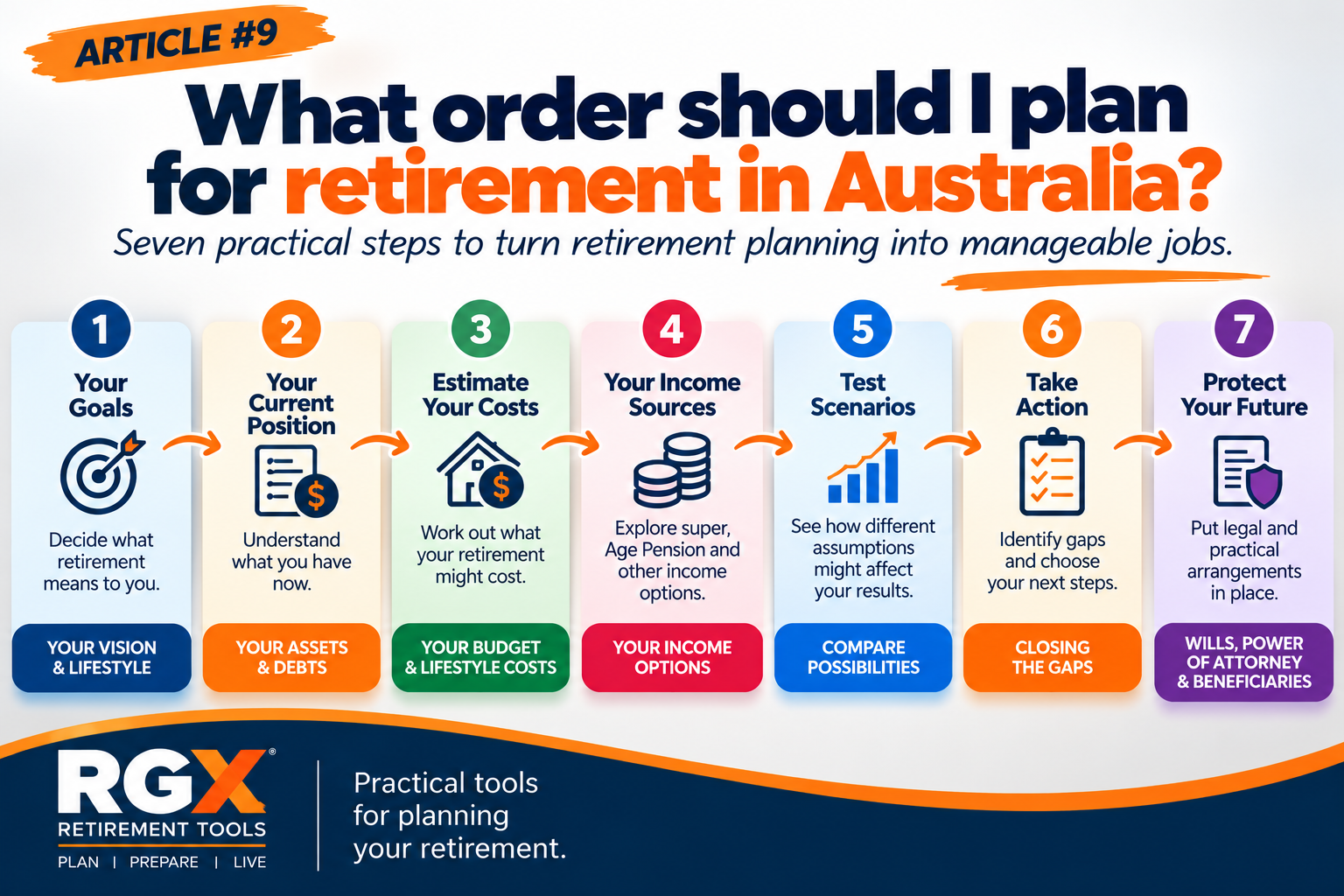
But if you're wondering where to start, the following seven-step framework can help you organise the process.
Step 1 — Decide what retirement means to you
Before starting with calculators and super balances, start with the life you're actually planning for.
Ask yourself:
- When would I roughly like to retire?
- Do I expect to stop work completely or gradually reduce my hours?
- Where would I like to live?
- Do I want to travel?
- What hobbies or activities matter to me?
- Will I financially support children, grandchildren or other family?
- What might healthcare look like as I get older?
You don't need every answer.
You're simply trying to establish a direction.
The Australian Government's Moneysmart retirement guidance similarly recommends thinking first about when you may retire and what you want retirement to look like.
That's important because your lifestyle influences almost everything that comes next.
Moneysmart — Plan for your retirement
Step 2 — Work out where you stand today
Once you have an idea of the retirement you want, take a snapshot of your current position.
Write down your:
- superannuation balance
- savings
- investments
- home and other property
- mortgage
- personal loans and credit cards
- other significant assets or debts.
Don't worry yet about whether the numbers are "good" or "bad".
The purpose of this step is simply to replace guesswork with a clearer starting point.
Check your super account as part of this process. Look at your balance, fees, investment option, insurance and whether you have other super accounts.
If you're considering consolidating super accounts, check whether you could lose insurance or other benefits before making a change.
Step 3 — Estimate what retirement might cost
Now connect the retirement you pictured in Step 1 with some numbers.
Start with your current spending and think about what could change after you stop or reduce work.
Your retirement budget might include:
- housing and utilities
- groceries
- transport
- insurance
- healthcare and dental costs
- hobbies and entertainment
- travel
- home maintenance
- vehicle replacement
- support for family
- unexpected expenses.
Some work-related expenses may disappear.
Other expenses may increase.
For example, you might spend less on commuting but more on travel, hobbies, your home or healthcare.
There isn't one retirement budget that is right for everyone.
The useful question is:
“What might my retirement cost based on the life I actually want to live?”
This is where a detailed retirement budget becomes much more useful than relying on a generic figure.
What Should I Include in a Retirement Budget?
Step 4 — Understand where your retirement income could come from
Once you have an estimate of what you may spend, look at how you might pay for it.
Retirement income can come from several places, including:
- superannuation
- the Age Pension or other government support, if eligible
- savings
- investments
- employment or part-time work
- business or other income.
For many Australians, retirement income won't come from just one source.
Super and the Age Pension can work together at different stages of retirement.
It is also important to understand that super access age and Age Pension age are not the same thing.
Under current rules, you can generally access super from age 60 if you retire or leave a job, and from age 65 whether you're working or not.
Age Pension age is currently 67, subject to eligibility requirements including residency, income and assets tests.
That difference can matter if you plan to stop working before Age Pension age.
You may need to think about how you will fund the years in between.
Moneysmart — Getting your super
Services Australia — Age Pension
Moneysmart — Age Pension and government benefits
Step 5 — Test whether the numbers work together
This is where retirement calculators become useful.
But don't use a calculator to produce one number and assume you've discovered your future.
Test different scenarios.
Scenario 1 — Lower spending
What happens if your retirement spending is a little lower than expected?
Scenario 2 — Your expected plan
What happens using assumptions you currently think are realistic?
Scenario 3 — Higher costs or different assumptions
What happens if costs are higher, investment returns are different or your plans change?
You can also test changes to:
- retirement age
- starting super balance
- annual spending
- future contributions
- investment returns
- inflation
- years in retirement.
The aim isn't to predict exactly what will happen.
It's to understand how changing assumptions may affect your retirement position.
A calculator is therefore better treated as a planning tool than a promise.
Step 6 — Identify the gaps and choose your next actions
Once you've compared your likely expenses with your possible retirement income, you can start identifying the areas that need attention.
You might decide to investigate:
- working a little longer
- reducing debt before retirement
- changing your planned retirement spending
- making additional super contributions if appropriate
- reviewing super fees, investment options and performance
- continuing some part-time or casual work
- checking possible Age Pension eligibility
- reconsidering a large planned expense
- building a larger cash buffer.
This doesn't mean you need to make every change.
It means your planning is now giving you useful questions to investigate.
And the earlier you identify a gap, the more time you may have to consider your options.
Step 7 — Put the legal and practical pieces in place
Retirement planning isn't only about income.
There are also important practical arrangements that can become increasingly important as you get older.
Consider reviewing:
- your will
- powers of attorney
- guardianship or healthcare arrangements where appropriate
- super beneficiary nominations
- insurance
- important financial and personal records
- where those records are stored
- whether someone you trust knows where to find them.
One important point that is sometimes overlooked is that your super does not automatically form part of your estate.
Your beneficiary arrangements with your super fund therefore deserve separate attention.
Estate-planning laws and documents can also differ between Australian states and territories, so legal advice may be appropriate for your circumstances.
Moneysmart — Wills and powers of attorney
Moneysmart — Who gets your super if you die
Estate Planning Checklist for Retirement in Australia
Then start the process again
Retirement planning isn't something you finish once.
Your circumstances will change.
Your super balance may change.
Government rules may change.
Your health may change.
Your family circumstances may change.
And what you want from retirement may change as well.
So after working through the seven steps, come back and review them periodically.
You may discover that Step 1 looks different at 62 than it did at 55.
That's normal.
A retirement plan should be able to change with you.
A simple retirement planning order
If the whole process still feels overwhelming, remember this sequence:
1. Picture the retirement you want.
2. Understand what you have now.
3. Estimate what that retirement may cost.
4. Identify where your retirement income may come from.
5. Test several scenarios.
6. Work on the gaps.
7. Put your legal and practical arrangements in order.
Then review it again.
You don't have to solve retirement in one weekend.
You just need to know what your next job is.
Where RGX Retirement Tools fits
RGX Retirement Tools has been designed around the same idea: break retirement planning into manageable jobs rather than trying to solve everything at once.
Different RGX tools can help you organise areas such as:
- retirement budgeting
- superannuation
- estate planning
- government benefits
- retirement travel
- pension planning
- retirement calculations and scenario testing.
You don't necessarily need every tool.
Start with the retirement question you're trying to answer now, complete that job, and then move to the next one.
That's a much more manageable way to build a retirement plan.
The 10-Step Retirement Readiness Checklist
Get the free checklistFrequently asked questions
What should I do first when planning for retirement?
A useful first step is deciding roughly when you would like to retire and what you want retirement to look like. Once you have that direction, you can assess your finances and estimate what that lifestyle may cost.
Should I start with my super balance or my retirement budget?
Both matter, but they answer different questions. Your super balance tells you part of what you have. Your retirement budget helps you understand what you may need. Comparing the two becomes much more useful once you have considered your other possible income sources as well.
When should I start planning for retirement?
There is no requirement to wait until you are close to retirement. Starting earlier can give you more time to understand your position and consider possible changes.
Is Age Pension age the same as the age I can access my super?
No. Under current rules, super can generally be accessed from age 60 if you retire or leave a job, and from age 65 whether you're working or not. Age Pension age is currently 67, and eligibility also depends on other requirements.
Do I need a financial adviser to make a retirement plan?
You can do a significant amount of retirement organisation yourself using information from trusted sources and your super fund. If you need personal financial advice or recommendations about financial products, consider speaking with an appropriately licensed financial adviser.
How often should I review my retirement plan?
Review it periodically and when something significant changes—for example your employment, health, family situation, retirement date, super balance, spending expectations or relevant government rules.
Final thoughts
Retirement planning becomes much easier when you stop treating it as one enormous decision.
Start with the life you want.
Understand where you are now.
Work through the numbers.
Test different possibilities.
Then deal with the next job in front of you.
You don't need to know exactly what your retirement will look like 20 or 30 years from now.
You need a plan that helps you make better decisions as you get closer.
Information contained in this article has been checked against current Australian Government sources as at 22 October 2026.
General information only. This article is educational and does not take into account your personal objectives, financial situation or needs. Government rules and eligibility requirements can change. Check current information from official Australian Government sources before making decisions.
General information only. This article is general in nature and does not take your personal circumstances, objectives or financial situation into account. It is not financial, legal or taxation advice. Consider seeking advice from a licensed professional before making decisions about your retirement.