How Long Will My Super Last in Retirement?
Published 13 October 2026 · 12 min read
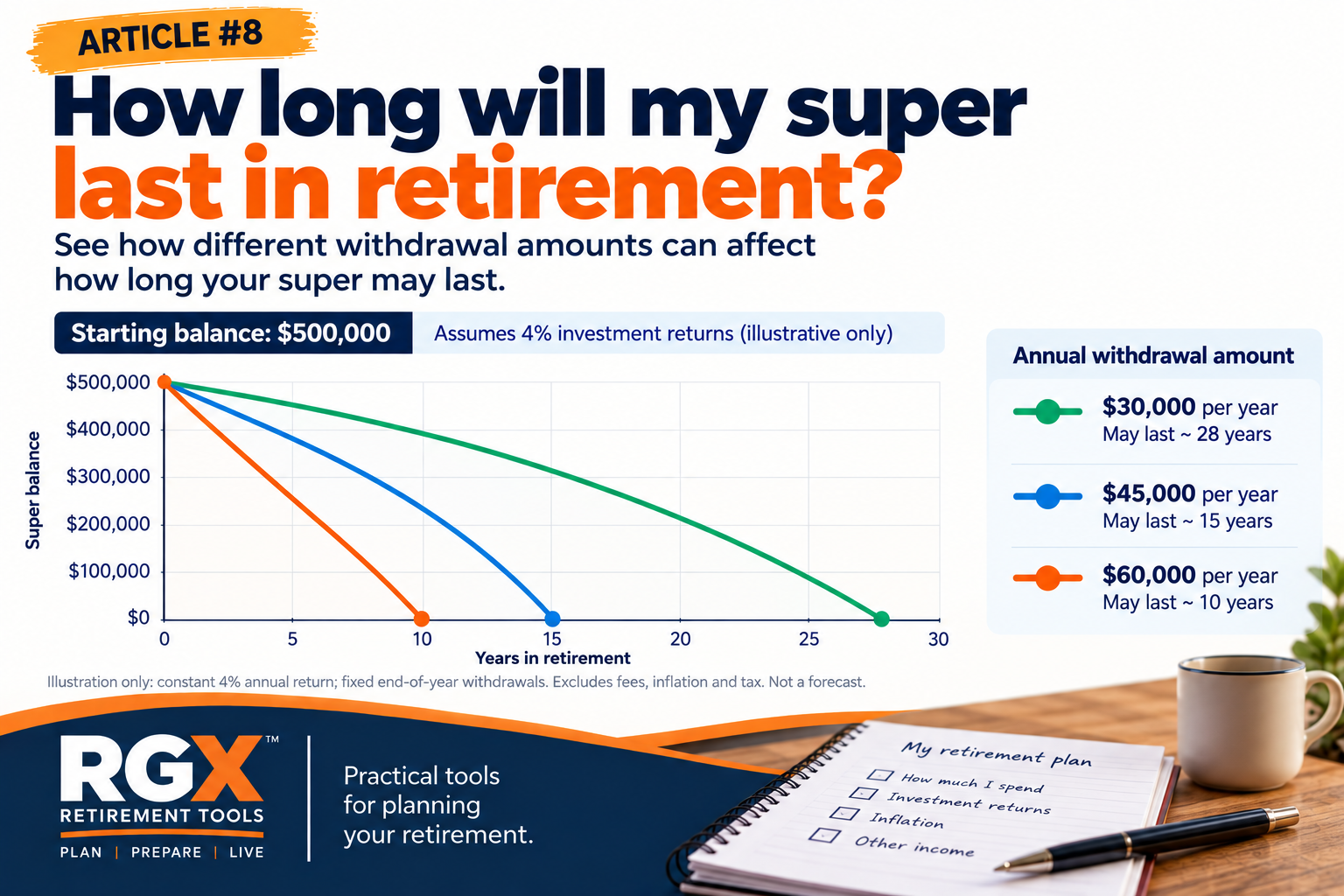
A practical Australian guide to understanding your retirement savings, withdrawals and income options.
One of the biggest questions Australians ask when approaching retirement is:
“Will my superannuation last as long as I need it to?”
It's an understandable concern.
After spending decades working and building your retirement savings, you want to know whether that money will support the lifestyle you're planning.
But there's something important to understand.
The amount of super you retire with is only part of the picture.
How much you spend, when you retire, how your investments perform and whether you receive other retirement income can all influence how long your super lasts.
The good news is that you don't need to predict the future perfectly to start planning.
You need to understand the numbers, consider different possibilities and review your plans as circumstances change.
Let's look at how that works.
1. How long does superannuation last in retirement?
There is no single answer.
Two Australians retiring with exactly the same superannuation balance could experience very different financial outcomes.
One might spend more in the early years of retirement, while another might maintain relatively steady expenses.
One might receive a part Age Pension, while another might not qualify.
Their investments may also perform differently.
According to the Australian Government's Moneysmart guidance, the lifespan of an account-based pension depends on factors including your starting balance, withdrawals, investment performance and fees.
Moneysmart — Account-based pensions
This means the more useful question is:
How long might my super last under different retirement circumstances?
That is something you can begin to estimate.
2. Start with how much you expect to spend
Before calculating how long your super might last, consider how much money you expect to need each year.
Retirement spending generally includes everyday living costs, occasional larger expenses and activities you want to enjoy.
| Expense category | Examples |
|---|---|
| Housing | Rates, insurance, repairs and maintenance |
| Everyday living | Groceries, utilities, clothing and transport |
| Healthcare | Medical appointments, prescriptions and dental care |
| Lifestyle | Hobbies, dining out and entertainment |
| Travel | Holidays, caravanning and visiting family |
| Unexpected expenses | Vehicle repairs, emergencies and major replacements |
Some expenses may decrease after retirement, while others could increase.
You might spend less commuting to work but more travelling.
You may also find that your spending changes throughout retirement.
A retirement budget should reflect the life you want to live, not simply the amount sitting in your super account.
For readers who haven't yet prepared a budget, RGX-101 Retirement Budgeting System can help organise their expected expenses.
RGX-101 Retirement Budgeting System
3. A simple example: How long could $500,000 in super last?
Let's begin with a straightforward calculation.
Imagine someone retires with $500,000 in superannuation.
They want to understand how long that balance might last under different annual withdrawal amounts.
| Annual withdrawal | Simple calculation — approximate duration |
|---|---|
| $25,000 | $500,000 ÷ $25,000 — 20 years |
| $35,000 | $500,000 ÷ $35,000 — 14.3 years |
| $45,000 | $500,000 ÷ $45,000 — 11.1 years |
These examples deliberately assume:
- No investment earnings or losses.
- No inflation or increases in withdrawals.
- No fees or taxes.
- No additional contributions.
- No changes to other income.
They are basic arithmetic illustrations, not retirement forecasts.
Actual account-based pensions are subject to minimum withdrawal requirements, which depend on age and account balance. A simple fixed-withdrawal example may not reflect those requirements in later years.
The table demonstrates an important principle:
How much you withdraw can make a substantial difference to how long your retirement savings last.
However, real retirement calculations need to consider more than dividing your balance by your annual spending.
4. Investment returns can change the outcome
Retirement savings don't necessarily stop being invested when you retire.
For example, Australians who move some of their super into an account-based pension may continue holding investments within that pension.
Those investments can increase or decrease in value.
If investments perform well, the balance may last longer than a simple calculation suggests.
If investments perform poorly, particularly during periods of substantial withdrawals, the balance may fall more quickly.
Investment fees also affect the amount remaining.
Moneysmart provides an account-based pension calculator that demonstrates how withdrawals, investment returns and fees can affect retirement savings.
Why the timing of investment returns matters
Imagine two retirees who experience similar average investment returns over several years.
One experiences significant losses early in retirement.
The other experiences those losses later.
Even with similar long-term average returns, their balances may develop differently because money is being withdrawn along the way.
This is commonly called sequence-of-returns risk.
It is one reason retirement projections should consider unfavourable market conditions rather than relying on one steady investment-return assumption.
A projection is a planning tool, not a guarantee of future investment performance.
5. Don't forget inflation
Inflation means that the cost of goods and services generally increases over time.
A retirement budget that covers your expenses today may not cover the same expenses in 10 or 20 years.
For example, imagine your annual living expenses are currently $40,000.
If those expenses increased by an assumed 2.5% every year, they would be approximately:
| Time | Approximate annual expenses |
|---|---|
| Today | $40,000 |
| After 10 years | $51,200 |
| After 20 years | $65,500 |
| After 30 years | $83,900 |
Figures are rounded and illustrate compound inflation at a constant assumed rate of 2.5%. Actual inflation will vary.
This does not mean every retirement expense will increase at the same rate.
Some expenses might disappear, while others could become more significant.
The lesson is straightforward:
When estimating how long your super may last, consider what your future spending could look like—not just what it costs today.
6. Consider three possible retirement scenarios
Rather than calculating one retirement outcome, consider several.
For example, imagine you're reviewing a retirement plan using the same starting super balance.
Scenario A — Lower spending and favourable conditions
Your expenses remain relatively controlled, and your investments perform better than your central assumptions. Your super might last longer than originally estimated.
Scenario B — Your central planning assumptions
Your spending, investment returns and other retirement income broadly follow the assumptions you've used in your plan. This provides a useful reference point for comparing other outcomes.
Scenario C — Higher costs and difficult investment conditions
Living expenses rise faster than expected, unexpected costs occur or investment returns are weaker. Your super might reduce more quickly.
These scenarios are not predictions.
Their purpose is to help you identify where your retirement plan may be more vulnerable.
For example, you might discover that a particular level of spending becomes difficult to maintain under less favourable conditions.
That information can help you understand what needs further consideration.
The aim isn't to find one perfect number. It's to understand how changing assumptions can change the result.
7. Your super and your retirement income are not necessarily the same thing
This is an important distinction that is sometimes overlooked.
How long your super lasts is not necessarily how long your retirement income lasts.
Australians may receive retirement income from several sources, including superannuation, the Age Pension, employment, personal savings and other investments.
Not everyone will have access to every source.
For some retirees, superannuation provides most of their income.
For others, it supplements the Age Pension or another source of income.
Moneysmart explains how different retirement income sources can work together.
Moneysmart — Retirement income sources
What happens if your super runs out?
If an account-based pension balance reaches zero, payments from that account generally stop.
However, that does not automatically mean all retirement income stops.
Someone may still receive income from other sources.
For example, an eligible retiree might continue receiving the Age Pension even after their account-based pension has been exhausted.
The amount payable depends on their circumstances and the applicable rules.
This is why retirement planning should examine your total retirement income, not only your super balance.
8. How does the Age Pension affect how long super lasts?
The Australian Age Pension may provide an additional source of retirement income for eligible people.
As at October 2026, Age Pension age is 67.
Eligibility also depends on residence requirements and income and assets tests.
Some Australians receive a full Age Pension.
Others receive a part pension.
Some do not qualify.
Importantly, receiving superannuation income does not automatically prevent someone from receiving the Age Pension.
The way superannuation is assessed can depend on age, whether it is in accumulation or pension phase, and other circumstances.
Services Australia applies income and assets tests when determining eligibility and payment rates.
Services Australia — Age Pension
Services Australia — Assets test for Age Pension
An example
Imagine a retiree needs $45,000 annually to cover their expenses.
If they receive $25,000 annually from other retirement income sources, they may need to withdraw approximately $20,000 from super to cover the difference.
Without that other income, they might need to withdraw considerably more.
This is only an illustration. It does not represent an Age Pension entitlement or calculation.
It demonstrates why different retirement income sources need to be considered together.
For more information, see the Australian Government's Super and the Age Pension guide. Moneysmart — Super and the Age Pension
9. Why your retirement spending may change over time
It's easy to assume that retirement spending will remain the same every year.
In practice, retirement can involve different stages.
Early retirement
You might spend more on travel, hobbies, home improvements or activities you've been looking forward to.
Middle retirement
Your priorities may change. Some expenses might decrease, while others remain relatively stable.
Later retirement
Healthcare, mobility, housing or support needs may become more important.
There is no universal spending pattern.
Your circumstances, health, family commitments and preferences will influence what you need.
Rather than assuming you'll spend the same amount every year, consider whether your retirement budget should change over time.
This can provide a more realistic starting point for retirement projections.
10. Five common mistakes when estimating how long super will last
Mistake 1 — Looking only at your super balance
A balance alone doesn't tell you how much retirement income you'll need or how long your savings may last.
Mistake 2 — Forgetting inflation
Using today's living expenses for a retirement lasting several decades can underestimate future costs.
Mistake 3 — Assuming investment returns will always be positive
Investment values fluctuate. Projections should consider the possibility of poor returns.
Mistake 4 — Ignoring other retirement income
The Age Pension, employment and other income sources can change how much you need to withdraw from super.
Mistake 5 — Calculating once and never reviewing
Retirement planning isn't a calculation you complete once and forget. Your spending, circumstances, investments and government rules may change. Regular reviews can help you keep your assumptions relevant.
11. How to estimate how long your super might last
You don't need to solve everything at once.
Start by gathering the information that matters.
Step 1: Check your current super balance.
Use your latest superannuation statement or account information.
Step 2: Estimate your balance at retirement.
Consider your intended retirement date, contributions and investment assumptions.
Step 3: Prepare a retirement budget.
Include essential living expenses, lifestyle spending and occasional larger costs.
Step 4: Identify other potential income sources.
Consider whether you may qualify for the Age Pension or receive other income.
Step 5: Compare different scenarios.
Change your spending, inflation and investment assumptions to see how the estimates respond.
Step 6: Review your calculations.
Revisit your assumptions when your circumstances change and periodically throughout retirement.
You can also use the Australian Government's Moneysmart account-based pension calculator to explore relevant estimates. Moneysmart — Account-based pension calculator
12. Bringing your retirement numbers together
Understanding your retirement savings is easier when your assumptions and calculations are organised.
You may want to compare different retirement dates, balances, spending levels and financial outcomes.
This is where a practical calculator can be useful.
RGX-107 — Retirement Calculator Pack
The RGX-107 Retirement Calculator Pack is designed to help Australians organise retirement calculations and explore different planning assumptions.
It can support the process of examining your retirement numbers rather than relying on one estimate.
Explore the RGX-107 Retirement Calculator Pack
Explore the RGX-107 Retirement Calculator Pack13. Frequently asked questions
Will $500,000 in super last 20 years?
Possibly, but there is no guarantee. A simple calculation shows that $500,000 divided by $25,000 annually equals 20 years. However, real outcomes depend on withdrawals, investment performance, inflation, fees and applicable pension rules.
Can I retire with less than $500,000 in super?
There is no single superannuation balance that determines whether every Australian can retire. Your retirement expenses, housing circumstances, other income sources and personal needs all matter. Someone with lower expenses and access to other retirement income may have different requirements from someone relying entirely on superannuation.
Does my super keep earning money after retirement?
It may. If your retirement savings remain invested, their value can rise or fall depending on the investment arrangements and market performance.
Can I receive the Age Pension while drawing from super?
Yes, some Australians can receive both. Eligibility and payment amounts depend on the applicable income and assets tests and other requirements.
What happens if my super runs out?
Payments from an exhausted account-based pension generally stop. However, other retirement income sources may continue, including the Age Pension if you qualify.
How often should I review my retirement calculations?
Reviewing at least annually is a practical starting point. You should also consider reviewing when important circumstances change, such as your spending, employment, health, family situation or retirement plans.
14. Final thoughts: Planning is more useful than predicting
Nobody knows exactly how long their retirement will last or what investment markets and living costs will do over the coming decades.
That uncertainty can make retirement planning feel difficult.
But it doesn't mean planning is pointless.
Understanding your expenses, knowing your available income sources and comparing different scenarios can help you make more informed decisions.
You don't need to predict every outcome.
You need a starting point, realistic assumptions and a willingness to review your plans.
Retirement planning is about understanding your options and preparing for the life you want to live.
Moneysmart — Make your money last in retirement
IMPORTANT INFORMATION
This article provides general educational information for Australians planning or managing retirement. It does not constitute personal financial, investment, taxation or legal advice.
Illustrative calculations are simplified examples and should not be treated as predictions, recommendations or guarantees.
Government rules, eligibility requirements and payment rates can change. Consider checking current official information and obtaining appropriately licensed professional advice where necessary.
Information reviewed against Australian Government sources: 13 October 2026.
General information only. This article is general in nature and does not take your personal circumstances, objectives or financial situation into account. It is not financial, legal or taxation advice. Consider seeking advice from a licensed professional before making decisions about your retirement.