How Does the Work Bonus Work for Age Pensioners?
Published 23 September 2026 · 9 min read
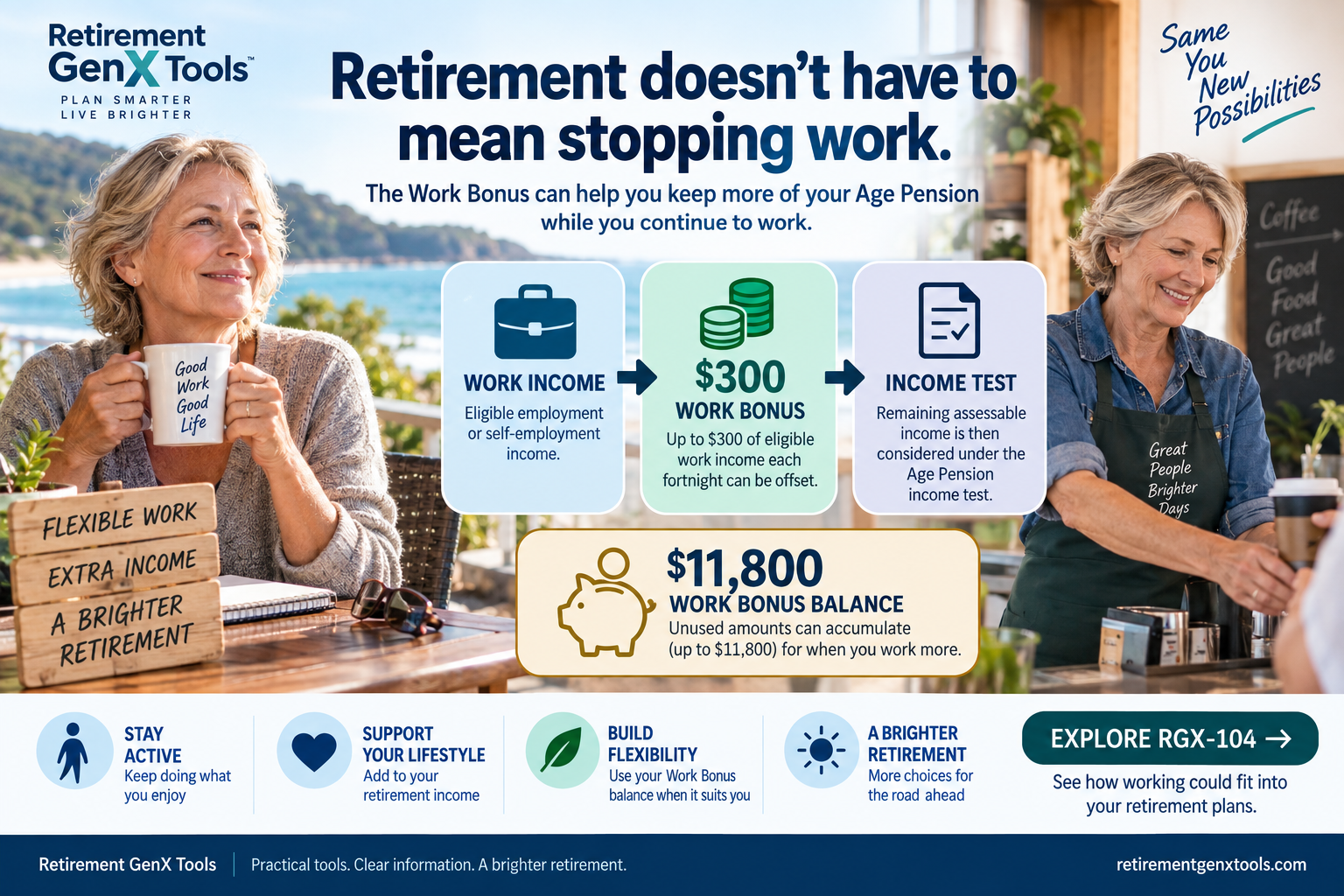
The Work Bonus can reduce how much eligible employment or self-employment income is counted under the Age Pension income test.
If you receive the Age Pension and continue working, the Work Bonus may help you keep more of your pension while earning employment or self-employment income.
Understanding how does the Work Bonus work is especially useful if you plan to work casually, seasonally, part time or on a self-employed basis during retirement.
The Work Bonus does not increase your wages and it does not replace the ordinary Age Pension income-test free area. Instead, it changes how some working income is assessed under the income test.
For the current overview, see Services Australia — Work Bonus
What Is the Work Bonus?
The Work Bonus is an Age Pension income-test concession for eligible employment and self-employment income.
It allows Services Australia to exclude up to $300 of eligible working income each fortnight before applying the Age Pension income test.
This means eligible pensioners may be able to earn income from work without that full amount immediately counting against their Age Pension.
Do You Need to Apply?
You generally do not need to apply for the Work Bonus. Services Australia applies it automatically when you report eligible employment or self-employment income.
You still need to report your income correctly and on time. The Work Bonus does not remove your reporting obligations.
Services Australia explains how the Work Bonus works
How Does the $300 Work Bonus Work?
Under the rules current as at 20 September 2026, the first $300 of eligible working income in a fortnight can be excluded from the Age Pension income test.
If you earn less than $300 in a fortnight, the unused amount may be added to your Work Bonus balance. If you earn more than $300, the standard $300 concession is used first, followed by any available Work Bonus balance.
Only the eligible working income left after those concessions is included with your other assessable income for the Age Pension income test.
What Is the Work Bonus Balance?
The Work Bonus balance lets you save unused Work Bonus amounts for a later fortnight when you earn more.
As at 20 September 2026, the balance can accumulate to a maximum of $11,800.
This can be particularly useful for people whose work is irregular or seasonal because unused concessions from quieter fortnights may reduce the amount of working income assessed in a busier fortnight.
See the current rules for your Work Bonus balance
Do New Age Pension Recipients Get a Starting Balance?
Eligible people receiving a qualifying pension for the first time can start with a $4,000 Work Bonus balance under the rules current as at 20 September 2026.
That starting balance can help if you are still working when your Age Pension begins. Your balance remains subject to the overall $11,800 maximum.
Does the Work Bonus Mean You Can Only Earn $300 a Fortnight?
No.
The $300 Work Bonus is not an earnings limit. It is the amount of eligible working income that can be excluded each fortnight before any available Work Bonus balance and the ordinary Age Pension income test are considered.
As at 20 September 2026, the ordinary Age Pension income-test free areas are:
| Circumstances | Income-free area per fortnight |
|---|---|
| Single | $226 |
| Couple combined | $396 |
These income-free areas apply to assessable income under the Age Pension income test. The Work Bonus is applied to eligible working income before that remaining income is considered with other assessable income.
Check the current Age Pension income test
A Simplified $500 Worked Example
Suppose a single Age Pension recipient earns $500 in eligible employment income during one fortnight and has no Work Bonus balance available.
The first $300 is excluded through the fortnightly Work Bonus. That leaves $200 of working income to be considered under the ordinary Age Pension income test.
Because the single income-free area is $226 per fortnight as at 20 September 2026, that simplified example would leave the person's $200 of remaining working income below the income-free area, assuming they had no other assessable income.
Real calculations can differ when a person has other income, a partner, an available Work Bonus balance or other circumstances, so this example is for explanation only.
What If You Have Built Up a Work Bonus Balance?
If your eligible working income is more than $300 in a fortnight, Services Australia can use your accumulated Work Bonus balance to reduce the amount left to assess.
For example, a person with a sufficient balance who earns more during a short period of seasonal work may have some or all of the amount above the standard $300 concession offset by that balance.
See what happens to the Work Bonus if you work
What Types of Income Can the Work Bonus Apply To?
The Work Bonus can apply to eligible employment income and income from active participation in self-employment.
It generally does not apply to passive income such as bank interest, dividends, rental income or superannuation income-stream payments.
The treatment of a particular payment depends on what the income is and how it was earned, not simply what you call it.
Services Australia lists the eligible types of income for the Work Bonus
What About Couples?
The Work Bonus is applied individually. Each eligible member of a couple can have their own fortnightly Work Bonus and their own Work Bonus balance.
However, Services Australia generally assesses a couple's combined income when working out their Age Pension rate. One partner's income can therefore affect the other partner's payment.
Read how Services Australia treats partner income and the Work Bonus
What If You Earn Enough to Stop Receiving the Age Pension?
If your income is high enough, your Age Pension may reduce to zero. Depending on your circumstances, your payment may be suspended for a period rather than immediately cancelled.
That can make it easier for your pension to restart if your income falls again within the permitted period, but you must continue to meet the applicable rules and reporting requirements.
See the current guidance on working while getting Age Pension
Working Can Still Be Worthwhile
A reduced Age Pension does not automatically mean working leaves you worse off. Employment income can still increase your total income, build savings and help you remain connected and active.
The better question is usually what your combined position looks like after wages, pension changes, tax, work expenses and any effect on other concessions are considered.
A Practical Way to Think About It
When you are considering work during retirement, write down:
- Your expected gross employment or self-employment income each fortnight.
- Whether that income is eligible for the Work Bonus.
- Your current Work Bonus balance.
- Your partner's income and circumstances, if applicable.
- Your other assessable income.
- The current income-test thresholds and reporting requirements.
This gives you a clearer starting point than treating $300 as a hard limit on what you are allowed to earn.
Bottom Line
The Work Bonus can help eligible Age Pensioners keep more of their pension when they earn employment or self-employment income.
As at 20 September 2026, it can exclude up to $300 of eligible working income each fortnight, unused amounts can build to a maximum balance of $11,800, and eligible first-time claimants can begin with a $4,000 balance.
It does not mean you can only earn $300, and it does not remove the need to report income. Your Work Bonus, available balance, other income and household circumstances all form part of the result.
Organise Your Government Benefit Planning
The RGX-104 Government Benefits Planner is designed to help you organise the information, documents and questions involved in understanding government retirement benefits.
RGX-104 Government Benefits Planner
Keep your Age Pension income-test information, Work Bonus details and application preparation together in one practical workbook.
Explore RGX-104General information only. This article is general in nature and does not take your personal circumstances, objectives or financial situation into account. It is not financial, legal or taxation advice. Consider seeking advice from a licensed professional before making decisions about your retirement.