Can I Get the Age Pension if I Have Super?
Published 14 September 2026 · 9 min read
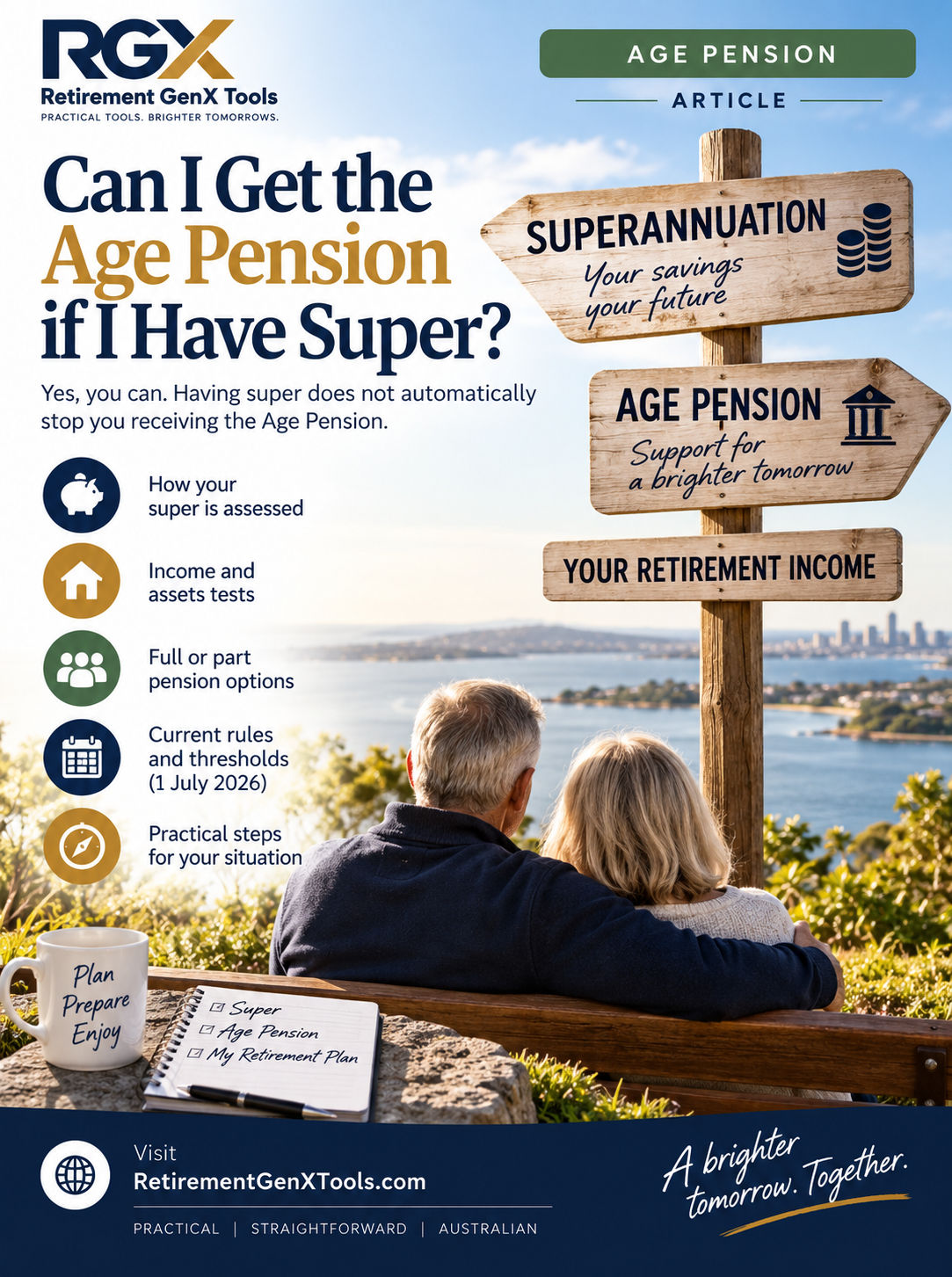
Yes. You can have super and still receive the Age Pension.
Having money in superannuation does not automatically make you ineligible for the Age Pension.
Many Australians fund retirement using a combination of superannuation and the Age Pension. How much Age Pension you may receive depends on your circumstances, including your age, residency, income, assets, relationship status and whether you own your home.
The important thing is understanding how your super fits into the Age Pension rules.
Super and the Age Pension Are Different Parts of Your Retirement Income
Superannuation is money accumulated for your retirement, generally through employer contributions and your own contributions.
The Age Pension is a government payment designed to help eligible older Australians with their living costs.
They are not necessarily an either/or choice.
For some retirees, super provides most of their retirement income. Others rely more heavily on the Age Pension. Many use a combination of the two, and that combination can change as retirement progresses.
For example, someone might retire in their early 60s and initially live mainly from super. Later, when they reach Age Pension age, they may qualify for a part or full Age Pension.
For current eligibility information, see Services Australia — Age Pension
What Age Can You Get the Age Pension?
Age Pension age is currently 67.
Reaching 67 does not automatically mean you will receive the Age Pension. You must also meet the applicable residence, income and assets rules.
This is different from accessing super.
Many Australians can access their super from age 60 after meeting an appropriate condition of release, while super can generally be accessed from age 65 whether or not you continue working.
That difference can be important when planning the years between finishing work and becoming eligible for the Age Pension.
Does Your Super Count Towards the Age Pension?
Once you reach Age Pension age, your super will generally be assessed.
Services Australia counts superannuation at Age Pension age under both the assets test, using the relevant value of your super, and the income test, where financial assets are generally assessed using deeming rules.
That does not mean having super disqualifies you.
It simply means your super becomes part of the financial information Services Australia considers when determining whether you qualify and, if so, how much Age Pension you receive.
Services Australia explains how it assesses superannuation for payments
What If You're Under Age Pension Age?
This is an important distinction.
If you're under Age Pension age, super that is not paying you a superannuation pension is generally not counted by Services Australia in the income and assets tests.
If the fund is paying you a superannuation pension, however, it can be assessable as an income stream.
The rules can also matter for couples where one person has reached Age Pension age and the other has not.
This is one reason retirement planning shouldn't look only at the total amount of super a household owns. Age, ownership and how the super is being used can matter too.
How Does the Assets Test Work?
The assets test looks at the value of assessable assets you and, where applicable, your partner own.
These can include superannuation once it becomes assessable; bank accounts; shares and investments; investment properties; vehicles; caravans and boats; household contents and personal assets; and some income-stream products.
Your principal home is generally exempt from the Age Pension assets test, although your homeowner status affects the asset thresholds that apply.
Services Australia calculates your entitlement under both the income and assets tests. The test producing the lower pension rate generally determines what you receive.
See the current Services Australia assets test for Age Pension
How Much Can You Have and Still Receive the Age Pension?
This is where it's important not to rely on an old article, social-media post or number somebody mentioned several years ago. The limits change.
As at 1 July 2026, the Age Pension assets-test cut-off for a part pension is listed by Services Australia as:
| Circumstances | Total assessable-asset limit |
|---|---|
| Single homeowner | $733,500 |
| Single non-homeowner | $1,000,500 |
| Couple combined homeowner | $1,102,500 |
| Couple combined non-homeowner | $1,369,500 |
These are total assessable-asset limits, not super balance limits.
There are also separate thresholds at which the full pension begins to reduce. Services Australia reviews Age Pension asset limits and cut-off points periodically.
So a statement such as “You can't get the Age Pension if you have $500,000 in super” is far too simplistic.
Someone's super balance alone does not tell you whether they qualify. Their other assets, income, relationship status and homeownership position also need to be considered.
What About the Income Test?
Services Australia also applies an income test.
This doesn't simply mean looking at how much money you withdraw from super every fortnight.
Financial assets such as savings, shares and assessable superannuation can be subject to deeming. Deeming assumes financial assets earn income at specified rates, regardless of the actual return in many circumstances.
This is another reason two retirees with similar super balances may end up with different Age Pension outcomes. Their overall financial circumstances may be quite different.
See the current Services Australia income test for Age Pension
Does Taking More Money From Super Reduce Your Age Pension?
Not necessarily.
What matters can be what happens to the money after it leaves super.
For example, withdrawing money from super and leaving it in a bank account generally does not magically remove it from the means tests — the bank balance itself may remain an assessable financial asset.
Using money to purchase another assessable asset can also simply change the type of asset you own.
Different rules may apply depending on what you do with the money, so making a large withdrawal purely to try to increase an Age Pension entitlement should not be done without understanding the consequences.
Can You Have a Part Age Pension?
Absolutely.
The Age Pension is not simply full pension or nothing.
If your income or assets exceed the thresholds for the full pension, you may still qualify for a part Age Pension until the applicable cut-off point is reached.
This is particularly important for Australians approaching retirement with moderate or substantial super balances.
Even if you don't expect to qualify for the full Age Pension, it can still be worth checking whether you may qualify for a part pension.
Your Position Can Change During Retirement
Your Age Pension entitlement today does not necessarily determine your entitlement for the rest of retirement.
Your circumstances can change. You may spend some of your super. Investment values can rise or fall. Your income can change. Your relationship or housing circumstances could change.
The mix between super and the Age Pension can change over time. Someone who initially relies mainly on super may later become eligible for a part Age Pension.
That's why retirement planning should not finish on the day you retire. It needs reviewing.
Don't Spend Money Just to Qualify for the Pension
It can be tempting to look at an Age Pension threshold and think: “If I reduce my assets, I'll get more pension.”
But receiving a larger Age Pension does not automatically mean you'll be financially better off.
The objective should be to build a sustainable overall retirement income, not simply maximise a government payment.
Before giving away money, making large purchases, changing investments, withdrawing significant amounts from super or restructuring your finances, understand the broader consequences. There are also specific rules around gifting and the treatment of different assets.
Think About Super and the Age Pension Together
A better retirement question is not simply: “How much Age Pension can I get?”
It is: “How can my super, Age Pension and other resources work together to fund the retirement I want?”
That changes the focus from chasing a pension threshold to building a retirement-income plan.
For some people, super may provide most of their income early in retirement. For others, the Age Pension may provide the foundation and super can provide additional money for travel, home expenses or unexpected costs. For many Australians, that balance will change over time.
Moneysmart also explains super and the Age Pension
A Simple Starting Point
Before estimating your Age Pension position, write down:
- Your super — current balance, whose name it is held in, whether it remains in accumulation or is paying an income stream.
- Your other financial assets — bank accounts, shares, managed investments, investment property and other investments.
- Your other assets — vehicles, caravans, boats, personal assets and other assessable property.
- Your income — employment income, investment income, other income sources.
Then record whether you are single or partnered and whether you are a homeowner or non-homeowner.
That gives you a much more useful starting picture than looking at your super balance by itself.
The Bottom Line
Yes — you can have super and still receive the Age Pension.
Superannuation and the Age Pension are designed to form different parts of Australia's retirement-income system, and many Australians use both.
Once you reach Age Pension age, your super will generally form part of the income and assets assessment. But having super does not automatically prevent you receiving a pension.
Depending on your overall circumstances, you may qualify for a full Age Pension, a part Age Pension or no Age Pension.
The important part is understanding the complete picture rather than making decisions based on your super balance alone.
Ready to Work Out Where You Stand?
The RGX-106 Age Pension Eligibility & Estimator is designed to help you bring the important information together and better understand the factors that may affect your Age Pension position.
RGX-106 Age Pension Eligibility & Estimator
Bring your super, assets, income and household details together in one practical retirement-planning workbook.
Explore RGX-106General information only. This article is general in nature and does not take your personal circumstances, objectives or financial situation into account. It is not financial, legal or taxation advice. Consider seeking advice from a licensed professional before making decisions about your retirement.